Skip to content

Cart

Your cart is empty

Article: What Is CoQ10 & What Does It Do?

What Is CoQ10 & What Does It Do?

What Is CoQ10 & What Does It Do?

CoQ10 appears on supplement labels, in skincare products and in conversations about energy and healthy ageing. But what does it actually do inside your body?

Coenzyme Q10, usually shortened to CoQ10 or Q10, is a substance your body naturally produces. It is found in almost every cell, where it helps mitochondria turn energy from food into ATP, the form of energy cells can use. In its reduced form, it also participates in the body’s antioxidant network.

This guide explains how CoQ10 works, where it comes from, what the research says about supplements and what to consider before adding one to your routine.

Aavalabs Editorial Team
Evidence reviewed against peer-reviewed research and guidance from EFSA, BfR and NCCIH. Last updated: July 2026.


Quick Answer

CoQ10 is a fat-soluble compound that helps cells produce ATP. Inside the mitochondria, it transfers electrons along the respiratory chain, an essential step in converting energy from food into a usable form. Its reduced form, ubiquinol, can also act as an antioxidant within cell membranes and lipoproteins.

The body normally produces its own CoQ10, while food supplies smaller amounts. CoQ10 supplements are available as ubiquinone or ubiquinol, but they do not work like stimulants and should not be expected to create an instant energy boost.

In This Guide


Key Takeaways

  • CoQ10 is made naturally by the body and found in almost every cell.
  • It transfers electrons within the mitochondrial respiratory chain, helping cells produce ATP.
  • Ubiquinol, its reduced form, participates in the body’s antioxidant network.
  • Ubiquinone and ubiquinol are two forms of the same compound, and the body can convert between them.
  • CoQ10 does not work like caffeine, and supplement research varies by population and outcome.
  • People taking medication should check with a healthcare professional before using CoQ10.


What Is Coenzyme Q10?

Coenzyme Q10 is a naturally occurring, vitamin-like compound. The “Q” refers to its quinone structure, while the number 10 describes part of its chemical side chain.

It is sometimes called ubiquinone. This name comes from the word “ubiquitous”, meaning found almost everywhere, because CoQ10 is present in the membranes of cells throughout the body.

Unlike an essential vitamin, CoQ10 does not normally have to come entirely from food. A healthy body can produce it using several nutrients and building blocks obtained through the diet.

CoQ10 is fat-soluble, which means it is associated with fatty structures in the body rather than dissolving freely in water. This characteristic is important both for its role within cell membranes and for the way supplemental CoQ10 is absorbed.

At a glance

CoQ10 is not a stimulant. It is part of the cellular machinery that allows energy production to take place.


What Does Q10 Do Inside Your Cells?

To understand Q10, it helps to look at the mitochondria, small structures inside most cells that convert energy from nutrients into a form the body can use.

One of the final stages of this process is the electron transport chain. CoQ10 acts as a mobile carrier, transferring electrons from complexes I and II to complex III. This contributes to a proton gradient across the inner mitochondrial membrane, which the cell uses to produce adenosine triphosphate, better known as ATP (Wang and Hekimi, 2024).

ATP supplies usable energy for processes including muscle contraction, nerve signalling, cellular transport, and the synthesis and repair of molecules.

In simple terms

CoQ10 helps connect the breakdown of nutrients with the production of cellular energy. It is part of the process, not a stimulant that creates an immediate burst of alertness.


How Does CoQ10 Act as an Antioxidant?

CoQ10 changes form as it accepts and transfers electrons. Its oxidised form is known as ubiquinone, while its reduced form is called ubiquinol.

Ubiquinol can donate electrons to unstable molecules and participate in antioxidant activity within cell membranes and lipoproteins. It is one part of a wider network that also includes antioxidant enzymes and nutrients such as vitamin E (Hernández-Camacho et al., 2018).

Oxidation is a normal part of energy production, immune activity and everyday metabolism. The goal is not to eliminate oxidation, but to maintain balance between oxidative processes and the body’s protective systems.

For a broader explanation, read Antioxidants and Cell Protection: Why They Matter Every Day.


Why Do the Heart and Muscles Contain Q10?

Different tissues have different energy requirements. The heart contracts continuously, skeletal muscles power movement, the kidneys filter blood and the liver carries out a wide range of metabolic tasks. These tissues contain many mitochondria and relatively high concentrations of CoQ10.

This explains why Q10 is often discussed in connection with the heart and muscles. However, the presence of CoQ10 in a tissue does not prove that taking more will improve its function.

For the cardiovascular research specifically, continue with CoQ10 for Heart Health.


Where Does Your Body Get CoQ10?

Most CoQ10 is produced inside the body. Its synthesis is a multi-step process that uses amino acids and other nutritional building blocks obtained through a varied diet.

Food supplies smaller amounts, with average dietary intake estimated at around 3 to 6 mg per day. Sources include meat, organ meats, oily fish, nuts, seeds, legumes and some vegetable oils (BfR, 2023).

That amount is lower than the quantities found in many supplements, but it does not mean the diet is inadequate. Food is not expected to provide the body’s entire CoQ10 supply because healthy cells normally produce most of it themselves.


Do CoQ10 Levels Decline With Age?

CoQ10 concentrations differ between tissues and can be influenced by age, genetics, health conditions and certain medicines.

This is sometimes simplified into the claim that everyone needs more Q10 as they get older. The evidence does not support such a universal conclusion. The German Federal Institute for Risk Assessment states that a healthy body normally produces sufficient CoQ10 and that there is currently no evidence of a general population-wide deficiency.

Age may affect tissue concentrations, but it does not automatically mean that every older adult needs a supplement.


What Is the Difference Between Ubiquinone and Ubiquinol?

Ubiquinone and ubiquinol are different redox forms of the same compound. The body converts between them as part of CoQ10’s normal function.

Form What It Is Useful Context
Ubiquinone The oxidised form Used in supplements for many years and included in substantial published research
Ubiquinol The reduced form Can act as an antioxidant and may produce higher blood concentrations in some formulations

Absorption varies between individuals and also depends on the formulation, dose and whether the supplement is taken with food. Ubiquinol is not automatically the best choice for everyone, and a well-formulated ubiquinone product can still be a practical option.


What Does the Research Say About Q10 Supplements?

CoQ10 has been studied in cardiovascular health, migraine, physical performance, statin-associated muscle symptoms, fertility, fatigue and several medical conditions.

Some studies and reviews report benefits for particular outcomes or patient groups, while others find little or no meaningful effect. Dose, formulation, study duration, baseline health and research quality all influence the results. The NCCIH overview of CoQ10 research provides a useful summary of the current evidence.

  • Research into CoQ10 and heart failure has produced mixed conclusions.
  • Overall evidence does not consistently show that CoQ10 reduces statin-associated muscle pain.
  • Evidence for a meaningful effect on blood pressure is limited.
  • CoQ10 has not been shown to treat Parkinson’s disease.
  • Evidence for several other uses remains too limited for firm conclusions.
Why the distinction matters

CoQ10’s biological role is well established. That is not the same as proving that additional CoQ10 produces a health benefit in every person. No health claims for CoQ10 are currently authorised in the EU (EFSA, 2010).


How Do You Choose a CoQ10 Supplement?

If you decide to use CoQ10, compare the full formula rather than judging a product by one front-label number.

Useful questions include:

  • Does it contain ubiquinone or ubiquinol?
  • How much CoQ10 does the recommended daily serving provide?
  • Is the ingredient source and production method clearly stated?
  • Does the formula contain relevant supporting nutrients?
  • Is the complete ingredient list transparent?
  • Has the product been tested for identity, purity and microbiological quality?
  • Does the serving fit comfortably into your routine?

A higher amount is not automatically better. Suitability, formulation, medication and individual needs should all be considered.


How Should You Take CoQ10?

CoQ10 is fat-soluble, so it is usually taken with a meal containing some fat. This may support absorption and can make the supplement easier to include consistently.

There is no universal best time. Many people take it with breakfast or lunch. Follow the serving stated on the product label, take it with food and water, and do not exceed the recommended intake.

If you combine several products, check for overlapping ingredients. For more guidance, read Supplement Interactions: What to Combine and What to Avoid.


Is CoQ10 Safe?

CoQ10 is generally reported to be well tolerated in studies, although digestive discomfort, nausea, diarrhoea, headache, sleep disturbance or skin reactions are possible (NCCIH).

Important

CoQ10 may interact with medicines, including warfarin and other anticoagulants. Possible interactions with blood-pressure medication, insulin and some cancer treatments also require professional consideration (NCCIH; BfR, 2023).

Speak with a doctor or pharmacist before use if you take regular medication, have a diagnosed condition, are preparing for surgery, or are pregnant or breastfeeding.


Common Myths About Q10

Myth: Q10 is a vitamin.

Fact: CoQ10 is sometimes described as vitamin-like, but it is not an essential vitamin because the body can normally produce it.

Myth: Taking Q10 gives you instant energy.

Fact: CoQ10 participates in mitochondrial energy production, but it does not stimulate the nervous system like caffeine.

Myth: Everyone produces less Q10 after a certain age and needs a supplement.

Fact: Age may influence CoQ10 concentrations, but there is no established universal deficiency or general supplementation recommendation for older adults.

Myth: Ubiquinol is always better than ubiquinone.

Fact: The body converts between the two forms. Absorption depends on more than the form alone, and neither is automatically the best option for everyone.

Myth: Q10 prevents heart disease.

Fact: CoQ10 has been studied in cardiovascular contexts, but it should not be presented as preventing or treating heart disease.

Fact: Individual studies have produced different results, and the overall evidence does not consistently support this use.

Myth: More Q10 is always better.

Fact: Higher amounts are not automatically more effective and may increase the likelihood of side effects or interactions.


In Summary

CoQ10 is a naturally produced compound that helps mitochondria make ATP and participates in antioxidant activity. These biological roles explain its association with cellular energy, the heart and muscles.

The body normally produces CoQ10 and food provides smaller amounts. Supplement research is still developing, and results depend on the people and outcomes studied.

If you choose a supplement, look for a transparent formula, take it with food and seek professional advice if you use medication or have a medical condition.


Looking for a Simple CoQ10 Formula?

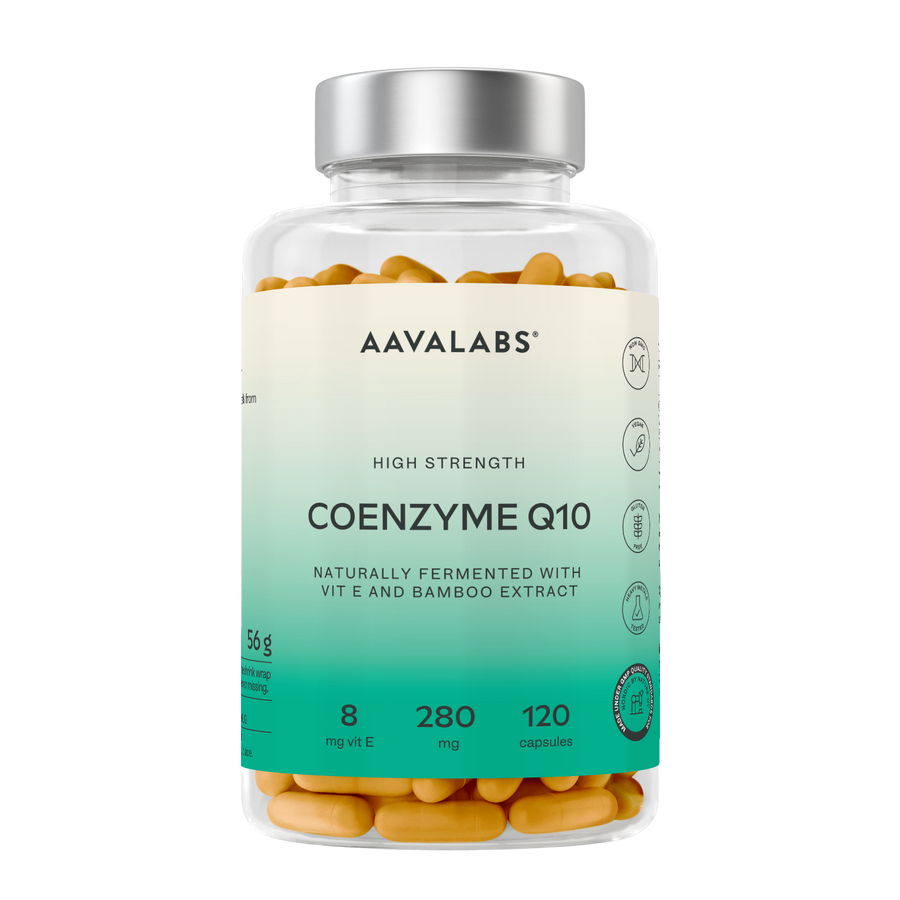
Aavalabs Coenzyme Q10 provides 275 mg of naturally fermented ubiquinone and 8 mg of natural vitamin E per daily capsule.

Vitamin E contributes to the protection of cells from oxidative stress. The vegan-friendly formula contains no artificial binders or fillers and is intended to be taken once daily in the morning with food and water.

Follow the recommended intake. For adult use only. Speak with a healthcare professional before use if you are pregnant or breastfeeding, take medication or have a medical condition.

Discover Aavalabs Coenzyme Q10

Frequently Asked Questions

What does Q10 do in the body?

CoQ10 transfers electrons within the mitochondrial respiratory chain, helping cells produce ATP. In its reduced form, ubiquinol, it can also act as an antioxidant in cell membranes and lipoproteins.

Is Q10 the same as CoQ10?

Yes. Q10, CoQ10 and coenzyme Q10 are commonly used to refer to the same compound.

Is CoQ10 a vitamin?

No. It is a vitamin-like compound, but the body can normally produce it. This means it is not classified as an essential vitamin.

Does Q10 give you energy?

CoQ10 helps cells produce ATP, but it does not work like caffeine. A supplement does not guarantee a noticeable increase in energy, particularly when the body is already producing sufficient CoQ10.

What foods contain Q10?

Meat, organ meats, oily fish, nuts, seeds, legumes and certain oils contain CoQ10. Food provides relatively small amounts because the body produces most of its own supply.

What is the difference between ubiquinone and ubiquinol?

Ubiquinone is the oxidised form of CoQ10, while ubiquinol is the reduced form. The body can convert between them. Ubiquinol may be absorbed differently in some formulations, but it is not automatically the best choice for everyone.

When should I take Q10?

There is no universally perfect time. CoQ10 is usually taken with a meal because it is fat-soluble. Follow the directions on your chosen product.

Can I take Q10 every day?

Many CoQ10 products are designed for daily use. Follow the label and seek professional advice if you take medication, have a medical condition, or are unsure whether it is suitable for you.

Can I take CoQ10 with statins?

CoQ10 is sometimes used by people taking statins, but research into statin-associated muscle symptoms is inconsistent. Speak with the healthcare professional who prescribed your medication before adding a supplement.

Can I take CoQ10 with blood thinners?

Do not add CoQ10 without professional advice if you take warfarin or another anticoagulant. CoQ10 may affect how some blood-thinning medicines work.

Is CoQ10 suitable during pregnancy or breastfeeding?

Safety information is limited. Ask a doctor or pharmacist before taking CoQ10 during pregnancy or breastfeeding.


References

Read more

Why Do We Crave Sugar? Causes and How to Reduce Cravings

Why Do We Crave Sugar? Causes and How to Reduce Cravings

Sugar cravings are not a willpower problem. They are biological signals driven by blood sugar swings, cortisol and poor sleep. Here is what your body is trying to tell you and what actually helps.

Read more